AI & Machine Learning
1/11/2026
Intelligent Knowledge Discovery and Content Generation Platform
A large enterprise struggled with scattered information across platforms, hindering productivity and collaboration. By implementing an intelligent knowledge discovery platform, they unified organizational knowledge, drastically reducing search times and enhancing decision-making and collaboration.
AI Agents
Large Language Models (LLMs)
Neo4j
Next.js
PostgreSQL
Python
langgraph
milvus
Project Breakdown
Challenges / Assignment
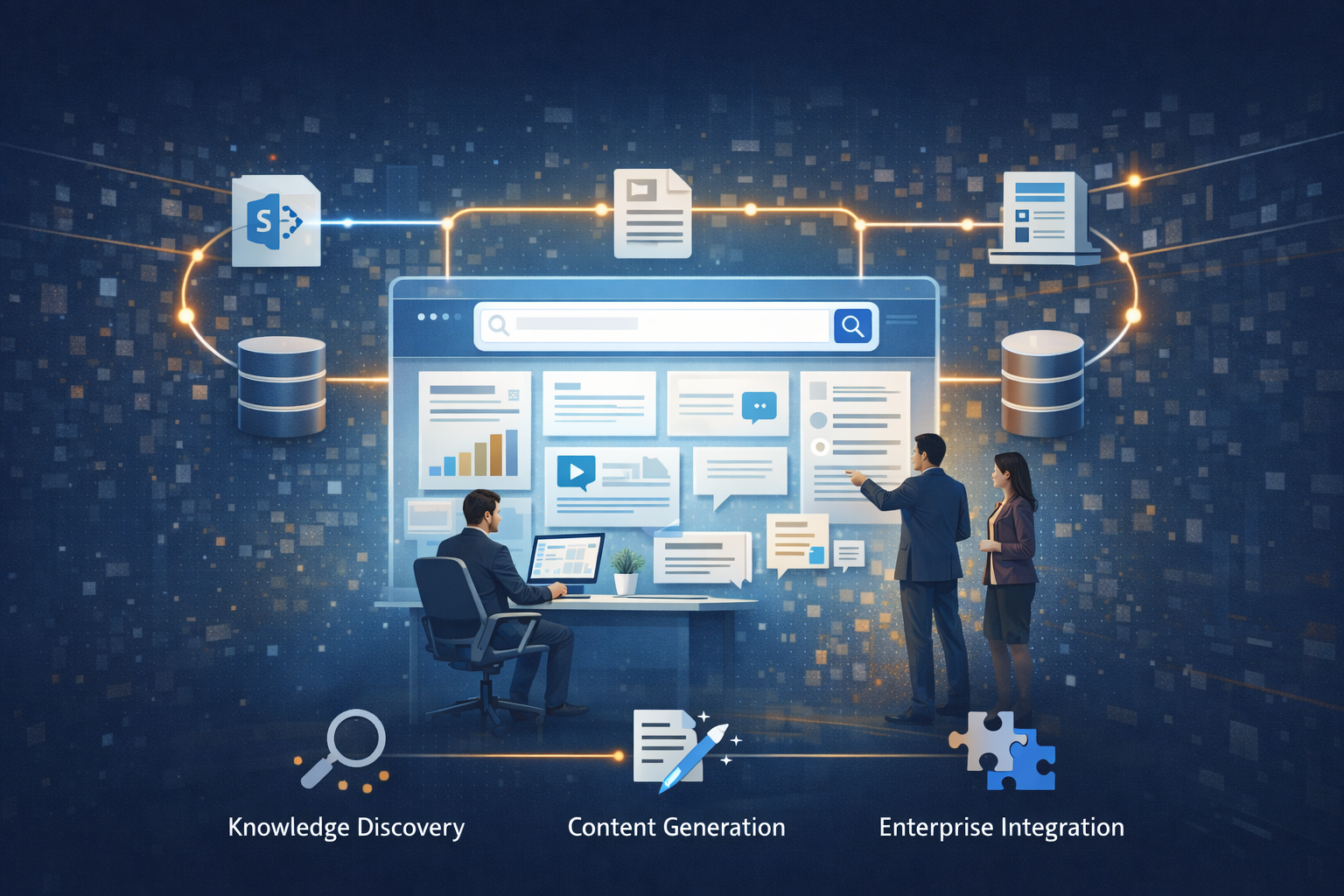
A large enterprise faced challenges with scattered information across platforms like SharePoint and internal wikis.
- Critical information was fragmented across multiple tools and platforms.
- Employees spent excessive time searching for relevant information.
- There was difficulty in finding context for meetings, project updates, and reports.
- Collaboration was slow due to fragmented information access.
- Productivity was reduced by repetitive information searches.
- Knowledge silos prevented efficient information reuse.
- There was inconsistent access to organizational knowledge across teams.
Solution
We developed an intelligent knowledge discovery platform to unify organizational knowledge.
- Integrated major data repositories into a centralized knowledge infrastructure.
- Implemented multimodal processing for documents, images, and structured data.
- Deployed vector and graph databases for information ingestion and relationship mapping.
- Built a document processing pipeline using messaging queue systems for scalability.
- Used large language models for natural language understanding.
- Developed a retrieval-augmented generation system for context-aware responses.
- Created content generation capabilities for summaries and reports.
Result
The new platform significantly improved information access and productivity.
- Dramatically reduced information search time from hours to seconds.
- Provided a single unified interface, eliminating fragmented tool switching.
- Delivered time-efficient, accurate answers from the entire knowledge base.
- Automated content generation for meeting summaries, reports, and presentations.
- Enhanced collaboration through faster information discovery.
- Increased productivity by eliminating repetitive searches.
- Promoted better knowledge reuse across departments and teams.
- Enabled enhanced decision-making with quick access to relevant context.